

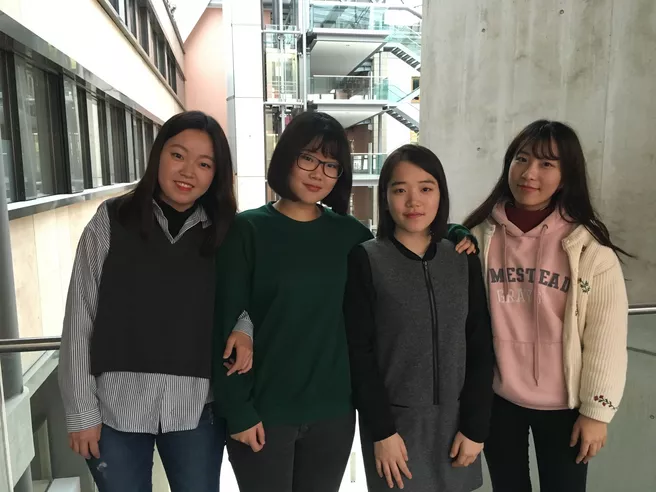

In December 2017 students from Korea met Professor Schreurs, Michael Ziegelmeier and Sarhan Habibaan in Hochschule für Politik München an der Technischen Universität München and made an interview about nuclear power plant and renewable energy. Here are their thoughts and impressions about the meeting:
#Jisoo Han
First, thank you for Habiba and Michael having time for us. It was an interesting experience to visit TUM and have a talk academically with the two smart students of the school in Germany. I learnt a lot from them. One of the things I was impressive about is triangle criteria, which are eco-friendly, sustainablity, safety for assessing a certain kind of energy such as fossil fuel, solar, and nuclear. It came to me a very systematic way to assess a certain kind of energy in determining what energy it is proper for society. What I was surprised at was that students like me are well aware of how people in their country think about energy policy. From this, I also learnt that having not only my own opinion but also participation is important for getting all the opinions together on the whole society for the future. About Professor Schreurs meeting, I was very delighted to finally meet her because it was a busy holiday season. Thank you for kindly welcoming my team and taking a picture of us. One of the most impressive things that I learnt at the meeting was that when we decide whether we shut down nuclear power plant or not we should consider all the opinions of social members even though the power plant is to be technically safe. Before that, as long as we become to have only safety technology to prevent nuclear accident, I would agree with re-implementing nuclear power plant concerning Korea has not still prepared enough for promoting alternative energy at the present in Korea. It will be scientifically fine, but it cannot be100% certain. Also, society is not all composed of scientists,which means safety is not the only problem that matters to all. The meeting gave me not only knowledge about germany situation on energy issue but also a rare experience to have time with an expert about the topic.
#Wonyeong Kim
I met the Professor and the students and talked about the policy of the nuclear power plant. The students were kind and we were able to talk in a relatively free atmosphere. It was meaningful because we were able to hear vision about nuclear power plant as German citizen. In addition, I was able to know the small information of Germany which was not found in the journals and the feelings and attitudes of the people. The time with Michael Ziegelmeier and Sarhan Habiba was more interesting. Both are experts, but had a different view on some of the issues. That point was more interesting and made us listen. I confirmed that the exit-nuclear policy was successfully combined with the historical situation, political situation, and environmental situation unique to Germany. We really appreciate the time we have been given. It was also an honor to meet you. Thank you so much!!
#Eunbi Jo
It was unforgettable experience to disuss common interests with foreign students. It was very interesting to learn their opinions beyond the preliminary investigation in Korea. Despite the differences in language and culture, I was impressed by the kindness I received and was happy to be able to communicate various opinions with them. Their comments helped me greatly to consider whether it was right to introduce the pre-nuclear policy in Korea right now. Thanks to Professor Schreurs, I was glad to have useful time with them. It was a great honor to meet Professor Schreurs, a de-nuclear power specialist, and I was able to learn a lot of things from her. In particular, I was impressed with her having the firm belief in the policy of existing nuclear power. Through discussion with her, I was able to reaffirm that the policy is not made by up to down, but is done by everyone. Meeting with her will help us to think about Korea nuclear power plant policy. Thanks for her.
#Jiah Jung
Hello! Let me introduce myself first. My name is Jiah Jung and I'm senior of Hanyang Univ. Seoul, and majoring in policy and economics. My 3 friends and I planned to travel to Germany for academic reasons. And our topic is about shutting nuclear energy down and renewable energy, as alternative. So we wanted to meet Professor Scheurs because she already visited Korea, and gave many useful advice to us. But that advice was maded as national level, not public level. Therefore, we thought that meeting Professor Schreurs might give lots of help. So we send e-mails and finally, we could interview the Professor. Above all, I really appreciate to Professor Schreurs because even though she quiet busy at that time, she was willing to met and gave advice to S.Korea and us. She let us know the way solving problem positively. And by that interview, I can collect the information and knowledge, without vias. In Korea, political parties use energy problem as attack to other party. But without them, I can hear fair information, and also know that I should filter the contents of media, full of wrong information and propaganda. Professor Schreurs also organized a meeting with the students from Technical University of Munich. It was very useful time because we could talk freely, as university students about our countries. Specially, I was very impressed by triangle model. I can't remember the exact name of that academic model. But now I can explain it to others, "the problem, whether Korea shut down nuclear energy or not, is up to what is matter. If energy security is very important issue to Korea, then we shouldn't use nuclear energy." By applying this model to Korea, we can easily conclude the energy plan. Additionally, Professor Schreurs introduced us to Professor Wurster who is majoring in energy policy. By talking and interviewing with him, we could get to know about reality of Germany, which didn't mentioned at Korean press. I think it is very meaningful, because it is the reason why we visited Germany. At first, I wondered if this interviewing could help me to accumulate my knowledge. But I was wrong, it was very very meaningful time to us and also to Korea.