

Yesterday, Stefan Ramesohl, Yasmin Djabarian, and Tobias Michl concluded our lecture series on sustainable digitalization, also known as digital sustainability, for now.
“We need a systems thinking approach. This involves understanding the interdisciplinarity and interdependence of systems and addressing their problems through critical thinking and self-reflection. Digitalization is useless if not steered toward sustainability. We must always ask ourselves: What do we need this for?” (Stefan Ramesohl)
“We want to improve education, which does not mean digital, but to use the advantages of digitalization. Digital tools help us connect like-minded people and people from different disciplines. We could utilize all the students' brainpower and innovative potential to facilitate the transition. But therefore we need structures that also allow us to use it.” (Yasmin Djabarian)
“There is also the need for incentives and not only regulation. Ultimately, digitization is a political task. Bylaws, funding, and the direction of the work are set. Research is always going the way the money flows…”
(Tobias Michl)
Let’s become the translators between engineers and social scientists, as well as between politics, businesses, and civil society. See you next semester with new old topics. We’re so excited to get things going!
Yesterday, Monika Egerer and Ferdinand Ludwig presented their work on urban ecosystems and biomorphic architecture. Living architecture, such as root bridges and greened office buildings, or agro-ecosystems like rooftop farms, is no longer a futuristic vision.
“Our city designs are still much about separation and not about synergies, this is completely outdated.”, as Ferdinand Ludwig explains. In the era of industrialization and standardized materials, the estrangement of humans, animals, materials, and plants seemed a forward-thinking concept. "Now we are working on reserving areas for insects, small mammals, flowers, crops, and humans mutually”, Monika Egerer concludes. These multifunctional, interconnected ecosystems not only provide us with food, cooling, and recreation, but also offer space for animals and strengthen our social grounding with the surroundings we live in and with our fellow human beings.
Greening the city pays back! We shouldn’t wait.


On Monday, Andreas Wanke provided us with a comprehensive overview of achievements since 2001 and outlined the next steps.
For instance, FU Berlin currently saves 29% of its energy consumption, which means 5.0 million. € in comparison to 2001. "Money is a language everybody understands. The biggest difference between FU Berlin and TU München is the budget.” TUM has the financial and human capacities, as well as the expertise, to achieve a similar goal.
Andreas Wanke also stressed that sustainability management is a cross-sectional task that requires multi-stakeholder processes. “You create a lot of work for a lot of people, so there has to be someone in the upper management of the university supporting the movement.” Let’s commit to climate neutrality!
For further information, including the sustainability reports from FU Berlin, please visit this link.
It's not about technology only!
Yesterday, Thomas Auer, Professor of Building Technology and Climate-Responsive Design at the TUM, delivered a phenomenal presentation. We are inspired!
"There are expert circles who say that the building industry is going to have its Volkswagen moment soon!” A moment, when society realizes the performance gaps and demands that stakeholders do better. “We can never do better if we tear down an existing construction.” Remarkably, the low-hanging fruit in reducing carbon emissions from buildings lies in adopting a culture of sustainability. "Every decision has to be based on the value of sustainability - top down and bottom up.“
Can TUM move beyond lighthouse projects and become a role model for climate-friendly construction? Our project groups are already working on it!


On Monday, Claudia Peus and Eva Sandmann gave us information about their work on gender justice, diversity, and participation at universities - and beyond.
"Luckily, it is not only women pushing women. People who have experienced diversity don’t tend to expect a person in a leadership position to be a white elder man”, as Claudia Peus reassures. Still, university structures tend to benefit this specific group with agentic characteristics. Therefore, TUM promotes more communal values through essential initiatives at the Gender Equality Office or the TUM Institute for Lifelong Learning.
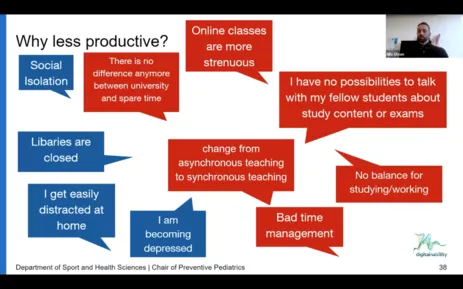
After the Pentecost break, Nils Olson from TUM4Health and Maren Orre from TUM4Mind opened our section on social digitainability and universities with a critical topic:
How digital semesters influence the student’s study-(work)-life balance - implications from the Corona Crisis
Before the pandemic, during the first and during the second lockdown TUM4Health gathered data about the TUM students’ study-work-life-balance and gained alarming insights: Whereas students enjoyed more flexibility (primarily through asynchronous teaching), felt encouraged to develop healthier behaviour and gained more free time during the first lockdown, students’ feeling of loneliness and lack of social interactions, difficulties in time management and perception of stress increased. Students rated their well-being using the WHO-5 Index 50 points lower during the second lockdown than before the pandemic. "We would have never thought that an online university could find its way into normality so quickly!” And it is definitely not ok that students seem to be among the greatest losers of the pandemic. We need a sincere discussion about alternative solutions in the coming winter term.
Feel free to reach out for help from TUM4Mind or TUM4Health at any time.
This was a fantastic conclusion to our section on the economic dimension of digitainability! As Marie Blachetta and Jens-Rainer Jänig from Initiative D21 pointed out, we are in a phase of ongoing discussion about “what we want, but also what we do not want when it comes to the digital transformation”.
Digital responsibility plays a key role in these debates, not only for corporations but also for the state and each of us. Additionally, universities possess significant potential for transparent data governance. But "there is no university yet involved in Corporate Digital Responsibility." Can universities like the TUM serve as important role models in this regard?
See you again after the Pentecost break, then with a new section on the social dimension of digitainability!
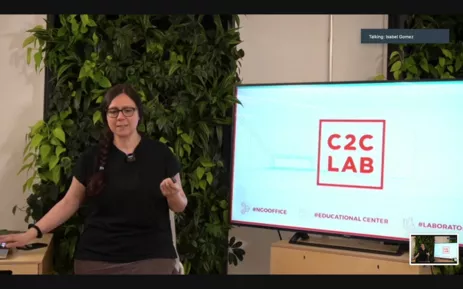
Thank you very much for your inspiring presentation and workshop! Isabel Gomez from the NGO Cradle to Cradle was with us on Monday. She brought tons of info for us on how products, businesses & universities could implement circularity ideas. "Cradle to cradle is a low-hanging fruit. It just makes 100% sense! But there has to be a systemic, holistic mindset."
A Blog entry from our project seminar Digital Sustainability Transformation of, by and for the TUM
from Elisabeth Paul
Circular Economy and the University
Sustainability. Not just since yesterday: scientific evidence strongly suggests that the way humans live and operate in this world endangers the continued existence of Earth's ecosystem. Key developments, such as climate change, the scarcity of finite resources, and other harmful effects of human post-industrial activities on the environment, are not empty doomsaying but serious developments that require a rethink across society, politics, and the economy.
But how can the maxim of sustainability be translated into daily actions? This blog post introduces a concept that aims for sustainable coexistence, without losing sight of the broader goal: a circular economy. What this concept means, how an application of a circular economy can look like, and which role universities, like the Technical University of Munich, can play in shaping it, will be the content of this post.
"Take, Make and Waste" is what humanity's current production and consumption patterns are based on. Still, there is increasing evidence that this linear thinking is pushing planet Earth to its planetary boundaries.1 To address the profound changes needed and to drive transformation in business and society, the concept of the Circular Economy can provide a holistic approach. At the heart of the circular economy is the demand that economic growth should be decoupled from resource consumption. "Waste" no longer exists in this sense; instead, resources are recycled and reused. In contrast to conventional recycling, resources at the end of their first use are seen as qualitatively equivalent raw materials for further use. In essence, two cycles of equal value can be identified side by side. A biological cycle, which circularly leads to renewable goods, and a technical cycle, in which commodities and their life cycles are considered.2
What is the role of a university in a circular economy, when it is primarily products and services that need to be rethought and redesigned for a circular economy? To answer this question in a nutshell: an essential one. A circular economy is not just about individual changes to some products here and there, but requires holistic, interdisciplinary thinking. The transformation from "cradle to grave" to a closed-loop economy affects numerous cross-cutting issues, encompassing a wide range of research areas. It requires new business models, new product designs, a new circular understanding of raw materials by both companies and customers, and new ways of production and consumption. All these changes can be initiated within a university, which is why the Technische Universität München can utilize the concept of a circular economy to train the necessary competencies through its teaching function, develop them through its research activities, and shape public perception and discourse with scientific evidence.
TUM has already taken the first steps in this regard, and a cluster such as "CirculaTUM" can help to bundle knowledge at the university and apply it in a targeted manner. The Circular Economy chair, led by Prof. Fröhling, is also an essential step in passing on the circular idea to students across all schools/faculties. The concept of sustainable change by interdisciplinary cooperation and collaboration between students is already inherent in the self-image of TUM, because the mission of TUM states that competences of the different disciplines, such as engineering and natural sciences and economics, humanities, social sciences, should be bundled to be able to bring sustainable research and knowledge transfer into cooperation, teaching, and also companies.3 The circular economy can be such a project, in which the cooperation of the disciplines is necessary, and universities could already demonstrate the future interdisciplinary cooperation. The challenges may vary in size and scope, but the urgency to find new methods of production and consumption remains consistently high.
As outlined in the Circular Economy Initiative of Germany, with the participation of experts from TUM, in the recently published Circular Economy Roadmap for Germany, science plays a crucial role in implementing a circular economy.4 The responsibility for implementing a circular economy cannot be placed solely on the economy or politics, but requires a strong scientific basis on which to make well-founded decisions and implement the necessary research. In concrete terms, this should mean that universities prioritize the circular economy in their research, teaching, and campus management.5
If the shift toward a circular economy is to succeed, there needs to be strong integration of the concept in every regard:
- In research, at new chairs and in trans- and interdisciplinary alliances,
- In teaching, through integration into the curricula of students in all disciplines,
- In everyday university life, through the promotion of student initiatives, the announcement of competitions with funding or real laboratories for circular projects,
- In campus management, through transparent communication about new projects, existing projects, and the current status quo, and by using certified cradle-to-cradle products at the university as a role model.
A circular economy offers an excellent opportunity for science, business, and politics to rethink processes in a new and sustainable way, and in doing so, to start a future that is equally livable for future generations. For universities, especially TUM, it is an opportunity to demonstrate how modern societies can research, teach, and work in the future, creating new projects through interdisciplinarity and diversity for a sustainable world with a circular economy.
A Podcast of our project seminar, Digital Sustainability Transformation of, by and for the TUM
by Darragh Power
With ComConsCafé: Conversations about the Commons over Coffee
Featuring: Grassroots activist, Tomás Lynch, from Dublin
Short: It's 9 May, Mother's Europe Day, and our first ever ComCons Café! Today, we introduce the broad topic of sustainability through the lens of progressive change strategies. We discuss the role of Europe on the global stage, whose specter continues to haunt our conversation, and about sites of revolutionary struggle from Haiti to Hong Kong and the Black Atlantic. Who are the agents of progressive change? What means must they employ to achieve their desired aims? How can we foster a sustainable international coalition? So join us in thinking about Democracy, SolarCommunism, and plenty more on Com! Cons! Café
Content
Introduction
00:46 - Europe Day: Values
05:56 - Zapatistas & Transatlantic Sites of Struggle
09:45 - Many-Headed Hydra and International Solidarity
16:45 - The Communist International
19:53 - "Fuck Europe and fuck the Nation State" - But what about the People?
23:06 - Community Action - from Local - through Mobile - to Global - and Back Again
27:14 - Political Sustainability - The Party: the Memory of the Working Class + Revising Dead Traditions
33:27 - Power and Measurement: Material Digital Infrastructure (Dosimeters, Tachographs, Finance)*
40:44 - Neither Tradition nor Crypto Decentralization: Collective Control of the Commons
44:45 - "Democracy is the Enemy" - from Shareholders to Stakeholders*
50:03 - "We Only Want the Earth" - our Internet, Cities, and Homes
55:46 - Post-scarcity and De-growth
57:43 - "Irish will Die."
59:19 - Sustainable Communal Luxury: Blossoming Culture in Public Spaces of Collective Enjoyment*
01:01:53 - Solar Communism (and Nuclear?)
01:07:07 - An Abrupt Ending
References
"The Many-Headed Hydra," by Peter Linebaugh and Marcus Rediker
"Economic Possibilities for Our Grandchildren," by John M. Keynes
"Seventeen Contradictions and the End of Capitalism," by David Harvey
"Automation and the Future of Work," by Aaron Benanav
"Zapatistas set sail for Spain on mission of solidarity and rebellion" article by David Agren in Mexico City and Sam Jones in Madrid

On Monday, Christian Felber gave an inspiring talk on how an Economy for the Common Good can work – and answered a ton of questions from the audience. At all levels – from global to local – the idea of an economy for the common good gains more and more traction. Universities are also experimenting with this holistic approach to achieve a more ethical approach to economics. What would a standard balance sheet for the TUM or the city of Munich look like?
Big thanks also to Christian Felber for participating in a workshop with us about his latest book!
Why does the economy repress its roots from Adam Smith to John Maynard Keynes? "Markets have never been natural self-regulating ecosystems, but social and political constructs.” Considering the history of oikonomia reveals that we are still trying to combine two truly distinct concepts: capitalism and economy. THIS IS NOT ECONOMY
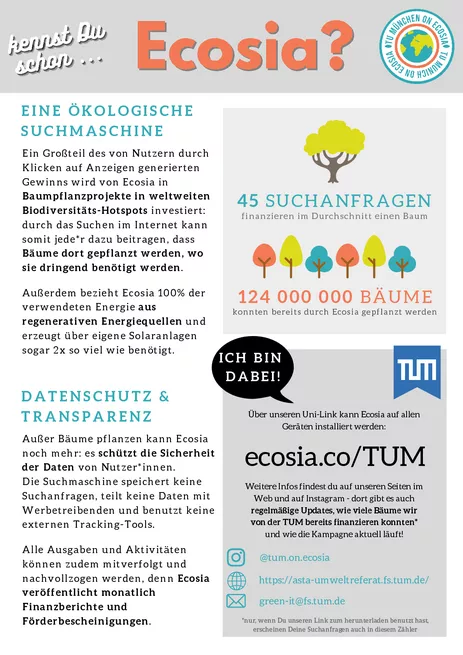
Thank you for sharing your knowledge about digital sustainability at universities with us on Monday!
Data literacy and soft skills - these are the key competencies students should look forward to acquiring in the future and the present, according to Florian Rampelt from the Hochschulforum Digitalisierung and the Stifterverband. But "online only" cannot be the formula; instead, blended learning and participatory approaches are essential. "Different learners have different needs and different needs need different formats."
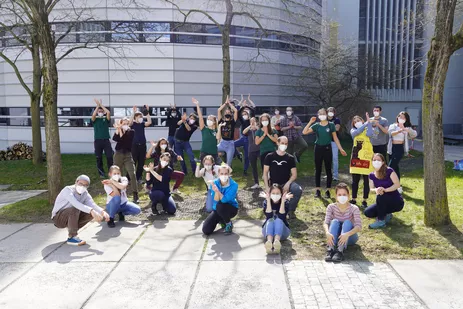
Yesterday evening, our lecture series "Digital Sustainability Transformation by, of and for TUM" started with our first guest speakers. The recorded lecture will be available on YouTube soon.
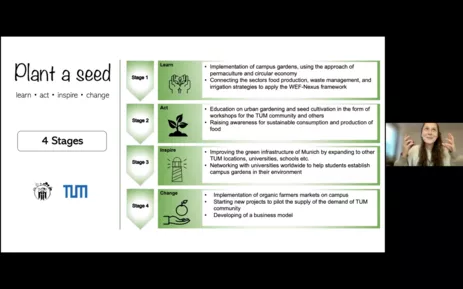
"We know what we want to do. We have to get our hands on it!" as Miranda Schreurs, Professor for Environmental and Climate Policy and leader of the TUM Task Force Sustainability, has put it. Now we are starters, working on networking and sharing experience, Lara Lütke-Spatz from the Bavarian Network for Sustainability in Higher Education outlines the future paths. Veronica Becker presented the new student initiative, Plant a Seed, at TUM.
Digitainability - that's how you could sum up the content and goal of the new elective event for Master's students of all disciplines at TUM in one word. If you want to know more about the project, here's the blog post (in German).