

TUM Political Theory and Philosophy Colloquium
Summer Term 2026

23 April 2026 (Thu), 15:00-16:30, H.414
Philipp Stehr, Hochschule für Politik München
Considering Resistance in Economic Institutions
Cancelled: Enrico Biale, Università degli Studi del Piemonte Orientale
From Populist Deconsolidation to Neo-Reactionary Rupture: Rethinking the Liberal Paradigm
21 May 2026 (Thu), 15:00-16:30, B.262
Johan Olsthoorn, University of Amsterdam
Theorizing Abolitionism
28 May 2026 (Thu), 15:00-16:30, H.414
Aliénor Ballangé, Paris Institute for Advanced Study
What Can Citizen Deliberation Mechanisms Do in Times of Democratic Backsliding?
18 June 2026 (Thu), 15:00-16:30, H.414
Chiara Destri, University of Milan
Political Trustworthiness and Representation
9 July 2026 (Thu), 15:00-16:30, H.414
Ana Honnacker, LMU Munich
A New World in the Shell of the Old? Prefigurative Practice and Ecological Transformation
Place
Hochschule für Politik München (HfP, Munich School of Politics and Public Policy), Richard-Wagner-Straße 1, 80333 München
Hybrid Workshop
Democracy-Participation-Expertise – Experimenting with Knowledge Systems

Place
TUM Think Tank Hochschule für Politik München (HfP, Munich School of Politics and Public Policy), Richard-Wagner-Straße 1, 80333 München
TUM Political Theory and Philosophy Colloquium
Winter Term 2025/26
23 Oct 2025 (Thu), 15:00-16:30
Sara Gebh, Department of Political Science, University of Vienna
Innovation durch Rückkehr: Machiavelli als Denker der Gegeninstitution
6 Nov 2025 (Thu), 15:00-16:30
Lena Siepker, Institute for Political Science, University of Münster
The Revolution won’t be deliberated (?) Theoretische Überlegungen zur Entfaltung des transformativen Potenzials von Mini-Publics
4 Dec 2025 (Thu), 15:00-16:30
Gordon Arlen, School of Social and Political Sciences, University of Melbourne
Liberal Plebeianism: A New Theory of Anti-Oligarchic Politics
22 Jan 2026 (Thu), 15:00-16:30
Verena Frick, Institute of Political Science and Sociology, University of Würzburg
Public space and the city. Why democrats should worry about urban public space
5 Feb 2026 (Thu), 15:00-16:30
Tweedy Flanigan, Faculty of Philosophy, LMU Munich
Nonviolence as Commitment to a Relationship
Place
TUM Think Tank, B.162
Hochschule für Politik München (HfP, Munich School of Politics and Public Policy), Richard-Wagner-Straße 1, 80333 München
CONTESTATORY DEMOCRACY
Workshop

December 4, 2025
Munich School of Politics and Public Policy (Hochschule für Politik München)
Programme
9.30
Welcome
9.45 – 10.30
Matthew Haji-Michael (Vienna): “How to Steal a Concept: Defining the Rule of Law under Conditions of Contestability”
10.30 – 11.15
Philipp Stehr (Munich): “Strikes as a Justifiable Contestatory Means? Between Self-defense and Expression”
Coffee Break
11.45 – 12.30
Frauke Höntzsch (Augsburg): “Democratize Liberalism”
12.30 – 13.15
Janosch Prinz (Maastricht) & Manon Westphal (Munich): “Oligarchic Democracy“
Lunch
All interested are welcome to attend (no prior registration required).
Place
TUM Think Tank, B.162
Hochschule für Politik München (HfP, Munich School of Politics and Public Policy), Richard-Wagner-Straße 1, 80333 München
Democratic Innovations Lab Launch
27. November 2025 | 16:30–19:00 PM | TUM Think Tank
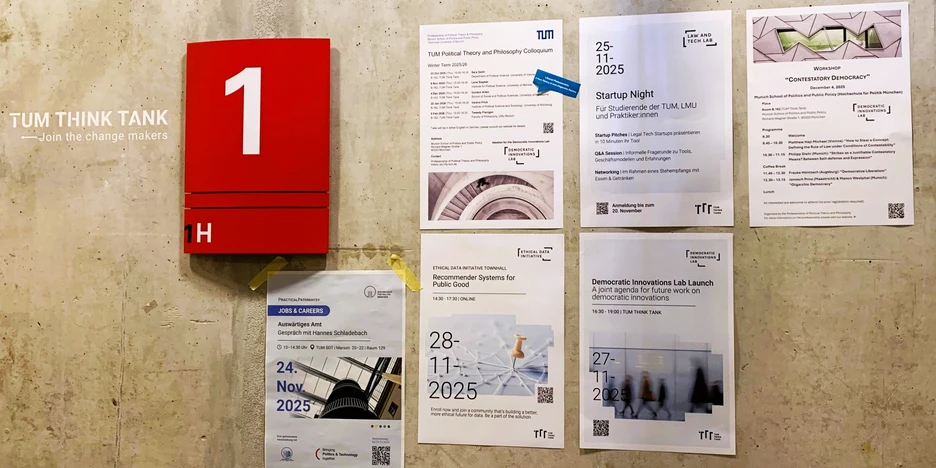
On November 27, 2025, we will launch the Democratic Innovations Lab with a public kick-off event. The Lab researches and tests new forms of democratic participation that can meet the social, political, and technological transformations reshaping our societies.
By bridging theory, empirical research, and practice, the Lab investigates how innovative participation formats emerge and how established models – such as citizens' assemblies – can be strengthened and adapted. It will research democratic innovations in the political as well as the economic sphere, examining how democratic processes can become more inclusive, effective, and sustainable. The Lab operates in partnership with leading organizations from research, civil society, and politics across Europe and beyond, creating a collaborative network dedicated to advancing democratic practice.
- 16:30 - 17:00 PM | After Work, Networking and Snacks
- 17:00 - 19:00 PM | Talks
Speakers will include Lab initiator Manon Westphal (Professor of Political Theory & Philosophy at the Munich School of Politics and Public Policy), Graham Smith (University of Westminster), Yves Dejaeghere (Federation for Innovation in Democracy Europe, FIDE), Anna Mikhaylovskaya (University of Groningen), and Hannes Kuch (Institut für Unternehmensdemokratie, IfU). The launch event aims to develop a joint agenda for future work on democratic innovations.
Registration
Place
TUM Think Tank
Hochschule für Politik München (HfP, Munich School of Politics and Public Policy), Richard-Wagner-Straße 1, 80333 München
New Publication
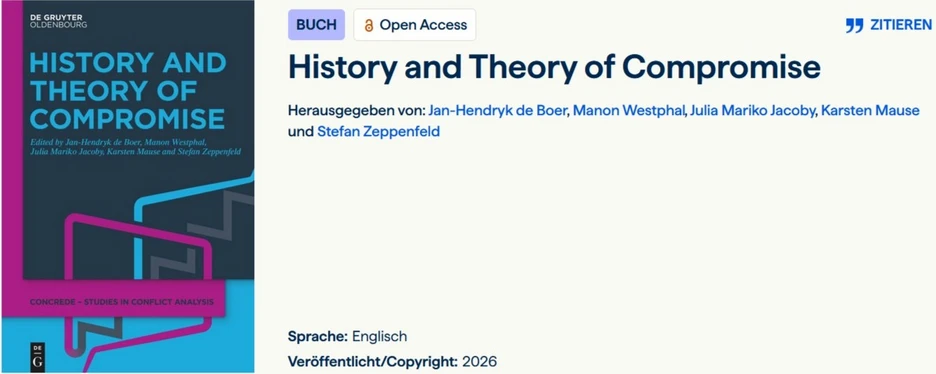
The volume "History and Theory of Compromise" has been published.
This book is a result of the interdisciplinary collaboration in the research network "Cultures of Compromise" and combines political science, philosophical, and historical analyses. It highlights a central finding of the research project: compromise is a conflict resolution technique that has been used at various times to deal with sometimes profound disagreements, but it can take very different forms. Interdisciplinary research is necessary to grasp the complexity of the practices and prerequisites of compromise.
Many thanks to Jan-Hendryk de Boer, Julia Mariko Jacoby, Karsten Mause, and Stefan Zeppenfeld for the opportunity to co-edit the volume, as well as to all the authors for contributing to this project!
Read the book here (open access).
Overcoming Oligarchy: Class-Specific Political Institutions in Democratic Theory
Workshop and Talk with Dr. Vincent Harting
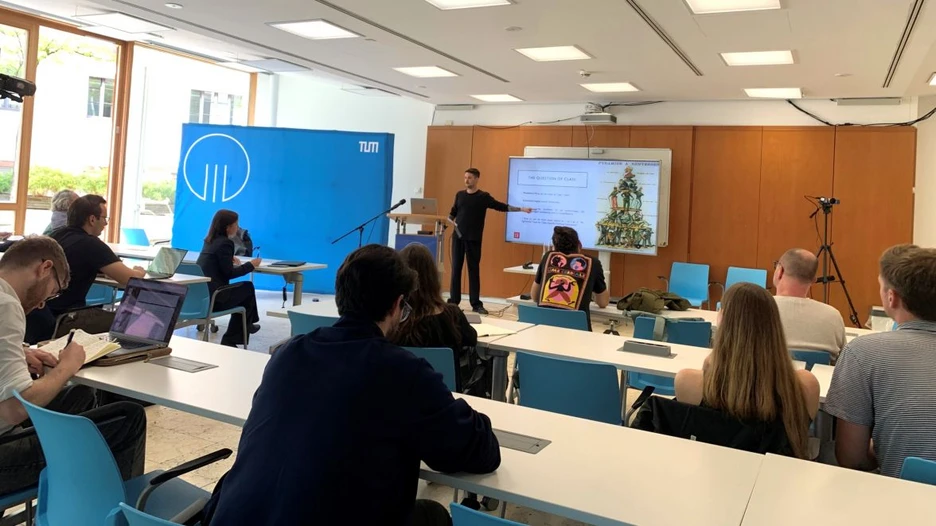
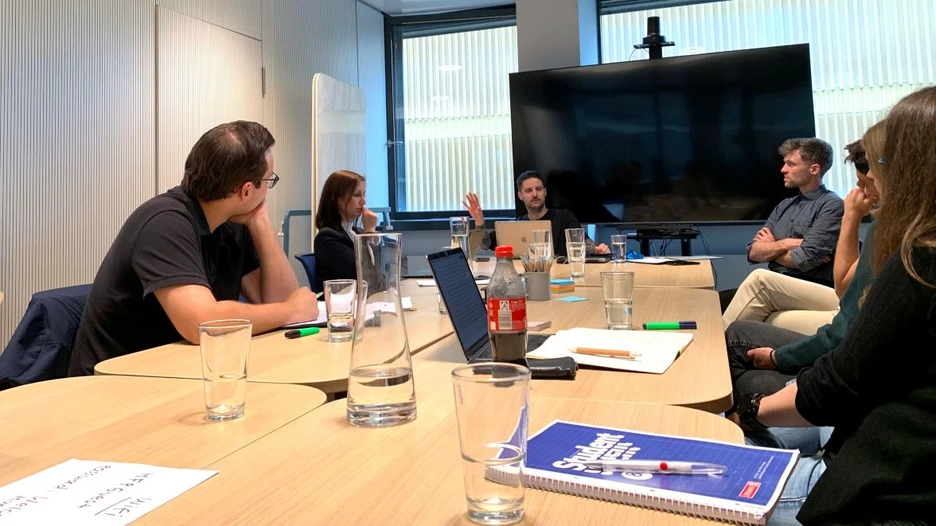
In July the Professorship of Political Theory and Philosophy held its first public event at the Munich School of Politics and Public Policy.
Dr. Vincent Harting (LSE) introduced his research in a workshop on “Egalitarian Corporatism and the Problem of Oligarchy.” Based on a draft paper by Harting, the participants discussed how democracies can counter tendencies towards economic inequality and power asymmetries. Harting provided a limited defence of a corporatist approach to this problem, arguing that an institutional system based on the organised representation of labour and capital interests can go a long way in combating power asymmetries. In the discussion with the audience, different aspects of this system were discussed further, for example whether we should think of “egalitarian corporatism” as an ideal or a transitional strategy, and how corporatist designs can provide mechanisms to ensure that the stabilization of representation and bargaining processes does not come at the expense of democratic accountability.
The following talk dived deeper into the idea of creating institutions with the specific goal of strengthening the voices of citizens from lower socioeconomic backgrounds in the political process. Vincent Harting here elaborated on both the rights-based and the instrumental reasons for class-specific institutions. In particular, he defended the idea that these institutions must be based on a specific socio-economic definition of class. The subsequent discussion with the audience then took up this issue, among other things, and further investigated how this concept of class could be defined.
Both parts of the event offered insight into the possibilities of institutions, and in particular novel institutional designs, to further economic justice and political equality.
Thanks to the engaged participants, some of them travelling to Munich from places as far as Vienna or Utrecht, and everyone who supported the organization at HfP and TUM, this first event was a great success.
The professorship is planning to regularly invite speakers from the broad range of perspectives in political theory and philosophy.
Overcoming Oligarchy: Class-Specific Political Institutions in Democratic Theory
Workshop and Talk with Dr. Vincent Harting
24th July 2025, Munich School of Politics and Public Policy (Hochschule für Politik München)
Contemporary democracies are characterized by multiple forms of inequality and power asymmetries. Because many of them are related to concentrated wealth, scholars speak of oligarchic tendencies in democratic societies. To counter such tendencies, democracies might need new institutions in the economic and the political realm.
During this event at HfP/TUM, political theorist Vincent Harting of London School of Economics and Political Science will present new work on the different forms that anti-oligarchic institutions could take.
The event has two parts, a workshop and a talk - please feel free to join either or both parts.
14:00 - 16:00 Manuscript Workshop
Vincent Harting will present a work-in-progress entitled “Egalitarian Corporatism and the Problem of Oligarchy”. The article will be pre-circulated. Participants are expected to read it in advance.
16:00 - 17:00 Coffee Break
17:00 - 18:00 Talk “On the Meaning and Value of Class-Specific Political Institutions”
Vincent Harting will share his research on the idea of creating institutions with the specific goal of strengthening the voices of citizens from lower socioeconomic backgrounds in the political process.
Registration (Closed)
Place
Munich School of Politics and Public Policy (Hochschule für Politik München), Richard-Wagner-Str. 1, 80333 Munich