

Neuigkeiten & Veranstaltungen
New paper in Governance
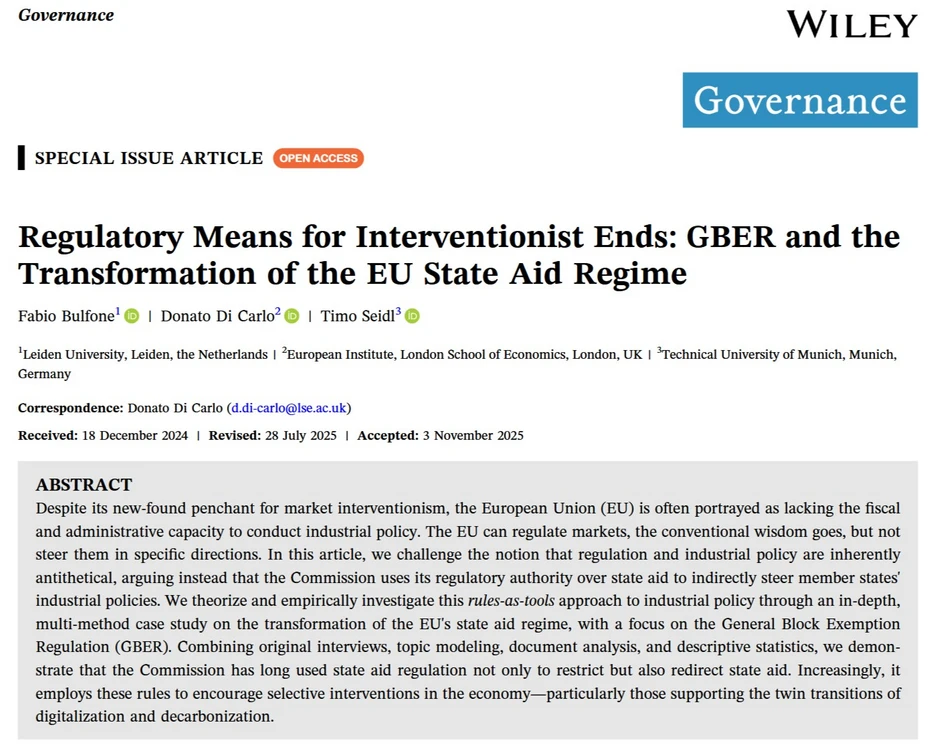
The EU is steering industrial policy without a federal budget. It does so through state aid rules – especially the GBER – now used not only to restrict subsidies, but to redirect them into green, digital and other strategic sectors. In 2023, 93% of non-crisis state aid measures fell under block exemptions.
In a new open-access Governance article Donato Di Carlo, Fabio Bulfone and Timo Seidl argue that this shift amounts to a form of regulatory industrial policy: the Commission increasingly governs industrial strategy by shaping how member states may subsidize firms and technologies.
Find an abstract and the full paper here.
New paper in Politics and Governance
After decades of relative retreat, industrial policy is back. Governments are once again trying to steer investment into “strategic” sectors and technologies.
But what actually counts as strategic – and how do states decide which areas deserve special protection or promotion?
In a new open-access paper in Politics and Governance, Tobias Wuttke and Timo Seidl investigate these questions empirically by looking at the EU’s flagship industrial policy instrument: Important Projects of Common European Interest (IPCEIs).
They draw on the literature on state capacity to introduce the concept of state capacity for strategic identification (SCSI), and trace how the EU has gradually institutionalised it. From the relative failure of the Strategic Forum to the relative success of the Joint European Forum for IPCEIs, they show how the EU is learning to identify and coordinate genuinely strategic projects.
This article is the first contribution to a new special issue Timo Seidl is co-editing with Salih Işık Bora and Fabio Bulfone on “Doing industrial policy in a geo-tech world”.
Read the paper here.
IPCEIs—or Important Projects of Common European Interest—have recently received a lot of attention in Europe's industrial policy discussions. For example, both the Draghi and Letta reports as well as the new Commission's political guidelines give it pride of place in Europe's emerging industrial policy edifice. As many have noted, the Treaty article on which IPCEIs are based goes all the way back to the Treaty of Rome but has remained largely dormant over the first decades of EU history. It was only in 2014 that the Commission decided to 'activate' this sleeping legal resource by introducing IPCEIs as a standalone policy instrument.
A new paper by Timo Seidl and Henrique Lopes-Valença offers a deep dive into the history of the IPCEI article, from its origins in the 1950s to the 2014 IPCEI communication. Introducing the concept of institutional activation, the paper sheds light on three historical episodes.
1. It offers a detailed reconstruction of how the 'IPCEI article' (today 107(3)(b) TFEU) emerged during the negotiations leading up to the Treaty of Rome.
2. It discusses how the article evolved over the ensuing decades, remaining mostly dormant despite some discussions in the 1980s to provide more explicit guidance.
3. It reconstructs how institutional entrepreneurs used the article to push for a more ambitious industrial policy in the context of state aid modernization, eventually resulting in the creation of a standalone policy instrument.
Find an abstract and the full paper here.
JEPP Best Paper Prize 2024
Timo Seidl and Luuk Schmitz (Max Planck Institute for the Study of Societies) won the JEPP Best Paper Prize 2024 for their paper ‘Moving on to not fall behind? Technological sovereignty and the ‘geo-dirigiste’ turn in EU industrial policy’.
They argue that historically Europe responded to fears of economic decline with 'market-creation', but more recently, the 'geo-dirigiste turn' has instead inserted more market-direction into the EU's industrial policy.
Many thanks also to the jury members Ben Crum and Antoaneta Dimitrova, who selected the paper from 152 substantive articles.
Read the jury statement here and the paper here.
New paper in Competition & Change
IPCEIs have recently emerged as a key tool in the EU's fast-growing industrial policy toolbox.
In their new paper in Competition & Change, Luuk Schmitz (Max Planck Institute for the Study of Societies), Tobias Wuttke (Bard College Berlin) and Timo Seidl take a closer look at how this instrument works on the ground.
IPCEIs provide an exception to the EU's state aid rules for 'important projects' that contribute to objectives 'of common European interest' such as Europe's competitiveness, strategic autonomy, or the twin transitions. They are subject to a complex governance architecture by which the Commission's Directorate-General for Competition wants to ensure that projects meet its demanding eligibility & compatibility criteria—which form the heart of the IPCEI conditionality regime.
Schmitz, Wuttke and Seidl argue that while the literature has rightly stressed that conditionalities are key to an effective and equitable industrial policy, conditionalities also come with costs and are shaped by the specific ideational, institutional and political constraints within which they emerge.
Based on descriptive statistics and comprehensive qualitative evidence from interviews and documents, they document three types of costs: perverse outcomes, adverse selection, and workarounds. For example, documenting and assessing that projects meet IPCEIs' eligibility & compatibility criteria creates high administrative burdens. This contributes, among other things, to unequal participation among member states & companies, with larger ones participating disproportionately.
Their argument is not to throw out conditionalities altogether, but to more carefully balance their costs and benefits as well as to think more carefully about the constraints that give rise to them.
With this paper, they aim to contribute to moving the debate on industrial policy from understanding why states increasingly resort to it to understanding how governments' new-found penchant for market activism actually plays out 'on the ground'.
Read the paper here.